

Anti Radio is known today for calm, ad-free music and an easy, uninterrupted flow. But long before it became that, Anti Radio lived a very different life. Its original story goes back to the mid-2000s, to a time when internet radio was raw, unfiltered, and proudly chaotic. This is a look at where Anti Radio really began, who built it, and why that first chapter ended in 2008.
Where it all started
Back in 2005, internet radio was still a digital wild west. There were no strict formats, no polished rules, and very little concern for being “brand-safe.” Anyone with a microphone, a server, and enough nerve could go live. Anti Radio was born right inside that chaos.
The project started in the United States as a direct reaction to corporate FM radio. Traditional stations were drowning in ads, censorship, recycled playlists, and safe conversations. Anti Radio wasn’t interested in fixing that system. It wanted to reject it completely.
From the beginning, the message was clear:
radio should be free, unfiltered, and uncomfortable if necessary.
The people behind the original Anti Radio
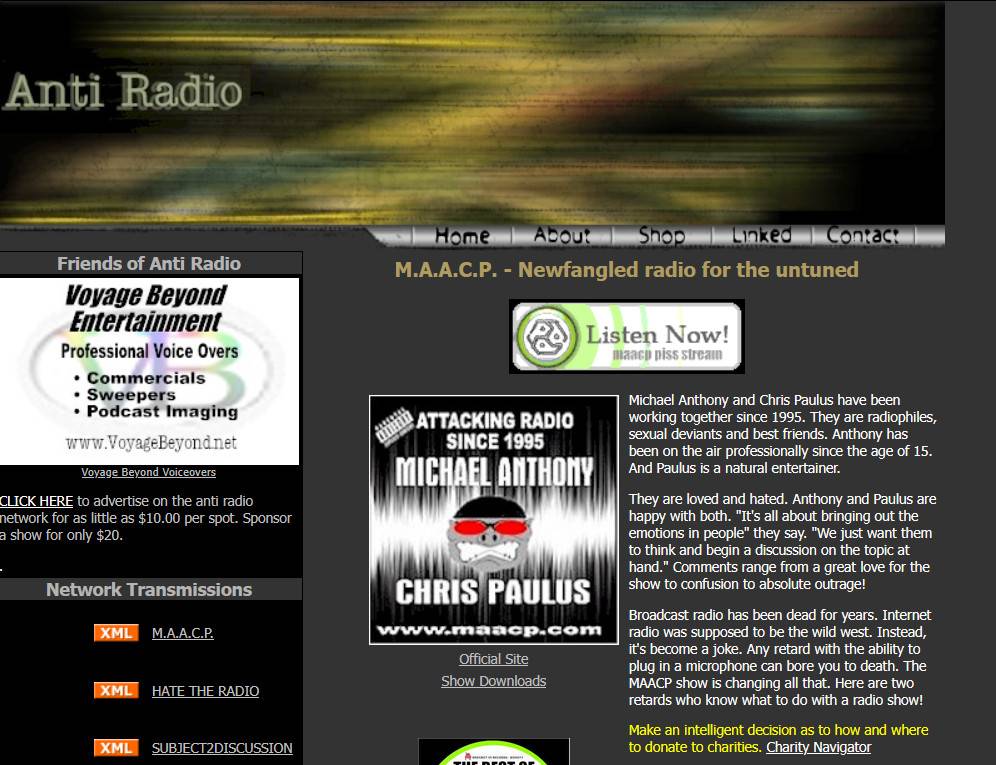
The early Anti Radio era revolved around Michael Anthony and Chris Paulus, two broadcasters who had been working in radio since the 1990s and were deeply frustrated with how predictable the medium had become.
Their flagship show, M.A.A.C.P., became the face of Anti Radio. It wasn’t polished. It wasn’t polite. And it definitely wasn’t safe. The language was harsh, the humor was intentionally offensive, and the topics often crossed lines on purpose.
The goal wasn’t comfort.
The goal was reaction.
Listeners either loved it or hated it. Very few felt neutral — and that was exactly the point.
2005–2008: when Anti Radio was at its peak
During its most active years, Anti Radio functioned less like a radio station and more like an underground movement. It mixed long, aggressive talk shows with alternative and independent music. Early podcast-style downloads were already part of the platform, long before podcasts became mainstream.
This version of Anti Radio was:
-
Uncensored internet radio
-
Strongly anti-corporate
-
Built on personality, not format
-
Proudly chaotic and rule-breaking
It didn’t try to please advertisers or fit into directories. It existed for people who felt radio had lost its soul.
Why it ended in 2008
By 2008, Anti Radio quietly stopped operating. There was no dramatic shutdown, just a natural ending.
The reasons were practical:
-
The project relied heavily on personal energy and volunteer work
-
There was no long-term financial structure
-
The internet radio landscape was changing fast
-
The core creators began moving in different directions
Anti Radio didn’t fail — it simply completed its mission for that era. It had already said what it needed to say.
Why today’s Anti Radio is different
The Anti Radio that exists today is not a continuation of the old management. It has a different operator, a different country, and a different philosophy. The early version shouted. The modern version whispers.
But both share one core idea:
corporate radio doesn’t get to decide what radio should be.
In the 2000s, rebellion meant being loud.
In the 2020s, rebellion means being quiet, ad-free, and listener-focused.
One name, two very different eras
Anti Radio’s history isn’t a straight line. It’s two distinct chapters under the same name.
The 2005–2008 Anti Radio was loud, abrasive, and confrontational.
The modern Anti Radio is calm, minimal, and music-driven.
They don’t look alike — but one could not exist without the other. Today’s quiet flow only makes sense because of yesterday’s noise.